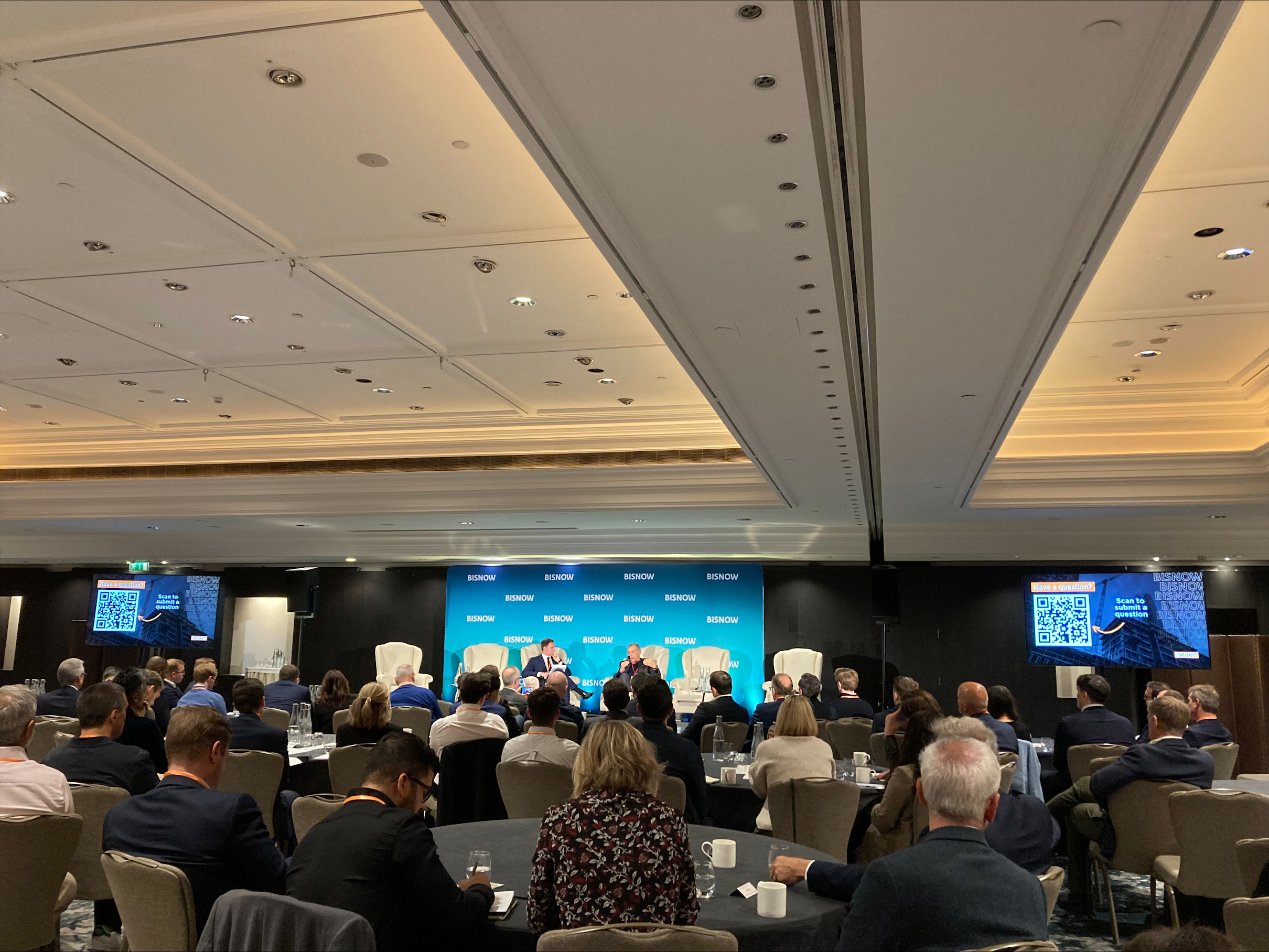
Hunters attends Bisnow’s London State of the Market



Bisnow’s London State of the Market Conference, held on Tuesday 13 October at the Intercontinental Hotel, London Park Lane, shared various forecasts and insights on the world of commercial real estate.
Sir George Iacobescu CBE, the Keynote speaker opened the conference by sharing his experiences of the development of Canary Wharf. Iacobescu spoke of the initial challenges faced by the development. For example, he spoke about challenging the historic pre-conception that the east of London was not the place to do business and the need for infrastructure and transport to serve the development. Whilst Canary Wharf has historically experienced waves of occupation and dis-occupation Iacobescu spoke about the importance of building quality developments and responding to user needs in bringing business to Canary Wharf, especially as businesses require diminishing space. In addition, Iacobescu touched upon his work with JP Morgan and the residential development at St Johns Wood. Iacobescu closed by encouraging developers to embrace the present and begin development today, indicating that waiting for the ‘perfect moment’ to begin is illusory and discouraging hesitation.
Nick Leslau of Prestbury Investments opened the first panel discussion addressing the state of the London market by highlighting the unpredictability of current times and the difficulty of pinpointing our place in the business cycle. Paul Tebbit, Global Co-Head of Real Estate at Black Rock echoed this by commenting that global real estate has experienced a tough period in the past years and a lack of long-term investment. Sandra Fives, Chief Strategy Officer at Catalyst commented that there is higher exposure to risk in a downward falling market leading investors to scrutinise quality. Andrew Jones, Co-Founder and CEO of London Metric countered by highlighting London’s competitive advantages compared to other cities, naming the benefit of the rule of law and the ability to have disputes settled more speedily in London, alongside the capital’s cultural qualities and superior infrastructure. Tebbit, responded by calling for greater transparency and liquidity. Tebbit commented that 50 countries are responsible for 60% of the deals in London and that to stay attractive the capital must avoid being seen as unattractive or politically unstable. Jones spoke about REITS (Real Estate Investment Trusts) which allow investors to buy shares without directly owning physical buildings.
The second panel discussion regarding ‘Building London’ commenced with dialogues around issues of planning delays and investor caution and highlighted that certainty not capital was the currency of development. Barabara Marina, Development Director at Keltbray, indicated that planning delays can make the attractiveness of development schemes unviable whilst Thomasin Renshaw, Managing Director of UK Development at Greystar called for planning reform and caps on claw backs. Nabeel Kahn, CEO of the Oxford Street Development Corporation spoke about the pedestrianisation of Oxford Street, a project that has been talked about for three decades. Nabeel indicated that there has been 44% vacancy on Oxford Street but that this is about to change in the future. He compared the transformation of Oxford Street, to the transformations of Kings Cross, Canary Wharf and Stratford. James Saunders, CEO of the Battersea Power Station Development Company commented on the difficulty of building the elegant buildings framing the power station due to obstructive regulations. Saunders elaborated on the Battersea development’s move towards building smaller plots and designing green spaces between the buildings. Following on from the theme of green spaces, Renshaw spoke about the Bermondsey development, a 16,000-home project at Pearl Yard designed to alleviate the undersupply of rental housing. She emphasised the importance of amenities, co-working spaces and gyms. However, lingering comments were also made on the many layered challenges facing development such as the Building Safety Levy and Retention Ban. Mark Cunningham, partner at Blick Rothenberg closed by speaking about the skill shortage in construction and the growing skills gap in the area alongside the importance of training to make the construction sector more attractive.
The third panel entitled ‘From Landlord to Operator’ started with Laura Wilson-Brown, Managing Director of Asset Management at Hines, commenting on the importance of retaining occupiers to avoid vacancy, pre-letting and reducing broker fees. Toby Courtauld, CEO of GPE spoke about observing 25% higher office occupation post covid and 25% higher office employment compared to 2015, indicating that whilst AI may remove jobs it will also create them. Nick Deacon, Head of Offices at Nuveen Real Estate spoke about WeWork and its aggressive historic growth which changed the way spaces are used, indicating that buying long leases was a strategic error for the business. David Woodman, Senior Customer Experience Strategy Director at Bewonder spoke about the importance of tracking customer satisfaction and actively monitoring attendance and use of amenities whilst eliminating friction points between service partners to deliver higher renewal rates and higher rentals.
The final panel dealing with ‘Where Capital Flows’ commenced with John Neale, Director at Montagu Evans, questioning where the next wave of international investment will come from. Neale commented on the mix of US and Japanese money and the rise of UK pension funds and UK DC capital. Uncertainty and political instability were named as a key reasons for 9 out of 10 investors not investing. Neale commented that capital flows to growth giving examples of southern Europe and Spain where growth potential has attracted capital. Martin Towns, Global Head of Real Estate at M&G Real Estate, countered the real estate industry’s aptitude for catastrophising the state of the market in his closing comments. Towns concluded the conference on a note of optimism, commenting on the potential of emerging prime real estate in winning cities.